
Boxing can be an excellent conditioning tool because it asks the heart, lungs, legs, shoulders, and core to work together under pressure. Is boxing good cardio? Yes, when the rounds are hard enough, the rest periods are short enough, and the session is organized like training instead of random punching. In this article, I break down what makes boxing so effective, how it compares with other cardio methods, and how to use it for conditioning without wasting time or beating up your joints.
Boxing can deliver real cardio, but only when the work is structured
- Boxing is usually vigorous-intensity cardio because it uses repeated bursts of effort with brief recovery.
- It trains more than endurance: footwork, coordination, trunk control, and muscular stamina all get taxed.
- A useful boxing session usually uses rounds, not random flurries, with about 1 minute of rest between efforts.
- Heavy bag work, mitts, shadowboxing, and sparring all stress the body differently, so the cardio effect depends on the format.
- For most people, boxing works best as part of a bigger conditioning plan that also includes strength and some lower-intensity aerobic work.
Why boxing works so well for conditioning
Boxing is built around a very specific stress pattern: hard work, short recovery, repeat. That pattern is what makes it such a strong conditioning tool. You are not just moving continuously like you would on a bike or treadmill; you are accelerating, bracing, rotating, slipping, and resetting over and over. That forces your heart rate up quickly and gives it only brief chances to come down.
The CDC says adults should aim for 150 minutes of moderate activity or 75 minutes of vigorous activity each week, and boxing fits the vigorous category when the rounds are honest. I like boxing for cardio because it feels athletic, not mechanical. A good round makes you manage breathing, timing, balance, and power at the same time, which is a much richer stimulus than simply trying to move fast for the sake of movement.That is why boxing conditioning can feel hard even when the session is short. The next question is what exactly it trains besides your aerobic system.
What a boxing session actually trains beyond your lungs
When I look at boxing from a conditioning standpoint, I see four major adaptations happening at once. First, it challenges your aerobic engine, which is your ability to keep producing energy while oxygen demand stays high. Second, it taxes anaerobic capacity, meaning your ability to produce force in short bursts before fatigue catches up. Third, it builds muscular endurance in the shoulders, core, calves, and hips. Fourth, it sharpens coordination so your movements stay efficient when you are tired.
| Quality | How boxing challenges it | Why it matters |
|---|---|---|
| Aerobic base | Repeated rounds keep oxygen demand high across the session | Helps you recover between exchanges and between rounds |
| Anaerobic capacity | Flurries, combinations, and defensive bursts demand quick output | Lets you surge without fading immediately |
| Muscular endurance | The shoulders, trunk, and legs stay active for the whole round | Keeps technique from falling apart under fatigue |
| Coordination and timing | You have to punch, move, breathe, and react at once | Makes the work more efficient and more athletic |
A 2026 UTEP study adds a useful real-world data point here. In young adults with elevated blood pressure or stage 1 hypertension, six weeks of boxing training done three times per week improved blood pressure and vessel function. The protocol used 10 three-minute rounds with one minute of rest, which is a good reminder that structured boxing can produce measurable cardiovascular change, not just a sweaty feeling.
That leads directly to the practical side: not every boxing workout gives you the same cardio benefit, and the format matters a lot.
How boxing compares with running, cycling, and jump rope
I would not say boxing replaces every other cardio option. It is better to think of it as a high-engagement, high-output conditioning method that sits somewhere between interval training and sport-specific work. Running and cycling are simpler to control when you want a steady aerobic dose. Boxing is better when you want intensity, movement quality, and skill demand in the same session.| Conditioning option | Cardio demand | Main strength | Main limitation |
|---|---|---|---|
| Boxing | High to very high | Full-body work, coordination, explosive intervals | Technique and fatigue can distract from steady aerobic volume |
| Running | Moderate to very high | Simple way to build aerobic base | Impact can be rough on some joints |
| Cycling | Moderate to very high | Low impact and easy to sustain longer efforts | Less upper-body and trunk demand |
| Jump rope | Moderate to high | Rhythm, footwork, and fast turnover | Can bother calves, shins, or Achilles tendons |
If your goal is pure aerobic mileage, I still like running or cycling as the cleaner tools. If your goal is to get fitter in a way that also improves timing, footwork, and whole-body coordination, boxing has a stronger case. In other words, boxing is not just cardio with gloves on. It is cardio with a skill requirement attached, and that changes the training effect.
That is also why the best boxing sessions are usually built around clear intervals instead of improvisation.
How to program boxing for better cardio
One of the biggest mistakes I see is people treating boxing conditioning like a vague sweat session. If you want it to improve cardio, give it structure. The simplest model is rounds and rest. A beginner might use 6 rounds of 2 minutes with 1 minute of rest. A more experienced trainee might use 8 to 10 rounds of 3 minutes with 1 minute of rest. That is enough volume to challenge the cardiovascular system without turning the session into a sloppy mess.
My rule is simple: the round should feel demanding, but you should still be able to keep your guard, breathe on purpose, and move with some control. If you are gasping so hard that your technique collapses by the second round, the session is no longer great conditioning. It is just uncontrolled fatigue. Work density matters here, which is simply how much useful effort you fit into each minute of the workout.
Use rounds instead of random flurries
Rounds force you to pace. Random punching usually creates a short burst of panic, then a long pause, and that does not train cardio nearly as well. A timer changes the session immediately because it makes your effort repeatable and measurable.
Choose the right modality
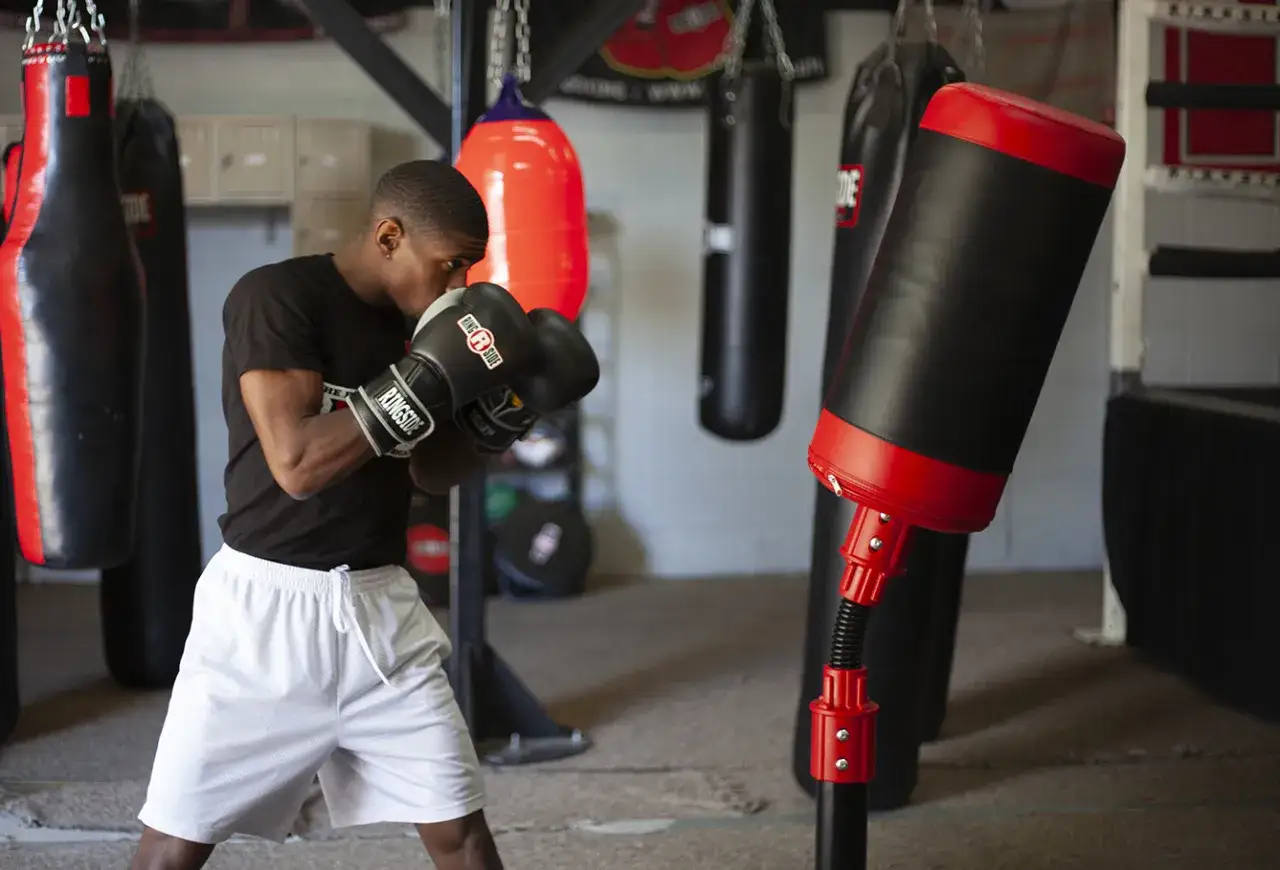
Shadowboxing is the easiest place to build volume because it is low impact and lets you focus on movement and breathing. The heavy bag adds resistance and makes you manage force output. Pad work is excellent if you have a coach or partner who can keep the pace honest. Sparring is the most demanding option, but it also carries the highest technical and safety requirements.
Read Also: Neck Harness Exercises - Build a Stronger, Resilient Neck
Track effort, not just sweat
Sweating is not a performance metric. I would rather see a session where your breathing stays controlled, your punches stay compact, and your footwork stays active than one where you are drenched after two minutes and barely moving. If the effort is right, the conditioning improves. If the effort is chaotic, you just get tired.
Once boxing is programmed well, the next issue is what usually goes wrong and makes people think it is harder than it actually is.
The mistakes that make boxing feel brutal but not productive
- Punching too hard in every round and burning out before the workout really starts.
- Planting the feet and forgetting to move, which turns boxing into arm fatigue instead of full-body conditioning.
- Letting rest periods become full disengagement instead of short, intentional recovery.
- Holding the breath during combinations, which spikes fatigue much faster than necessary.
- Ignoring hand wraps, glove fit, and wrist position, which can turn a good cardio session into an injury problem.
That matters because boxing is powerful, but it is not always enough by itself for every goal or every body.
When boxing is enough and when I would add something else
If your main goal is general fitness, fat loss support, better work capacity, and a more athletic feel, boxing can absolutely be enough as your main cardio pillar. Three solid sessions a week can go a long way if the rounds are hard and the rest is short. The 2026 UTEP trial is a good reminder that structured boxing can influence cardiovascular markers quickly when the protocol is tight.
I would add something else when the goal changes. If you need a bigger aerobic base, long easy sessions on a bike, rower, or incline walk still matter. If you want better durability, strength training should stay in the plan at least twice a week. If your wrists, shoulders, shins, or knees get irritated, lower-impact cardio will usually let you keep improving without forcing a break.
My practical view is that boxing works best as the highest-intensity piece of the week, not the only piece. Pair it with one or two lower-intensity sessions and a couple of strength blocks, and you get a more complete conditioning profile. That combination is usually better than trying to make every session brutal.
So if you want the short answer: boxing is excellent cardio when it is treated like a structured conditioning method, not a random pile of punches. Build rounds, keep the rest honest, stay technical under fatigue, and use other forms of cardio when your body or your goals call for them. That is the version of boxing that actually improves fitness instead of just making you tired.