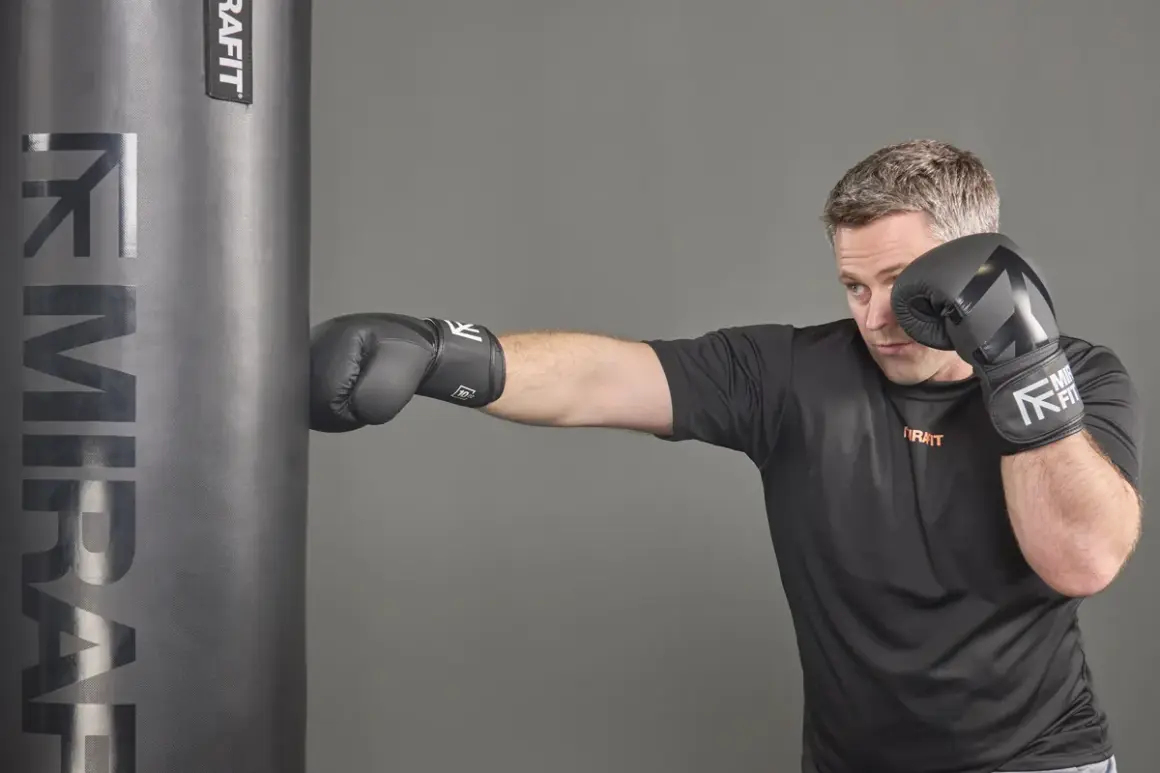
Boxing is one of the clearest examples of a workout that trains the body as a chain rather than a set of separate parts. The visible action is a punch, but the real load comes from the feet, hips, trunk, shoulders, and arms working together under speed and fatigue. In this article, I break down which muscles boxing trains most, how different punches shift the demand, and what to do if you want better conditioning instead of just tired shoulders.
Boxing trains the body as a chain, not as isolated muscles
- The biggest workload usually lands on the legs, hips, core, shoulders, and upper back.
- Power starts from the floor and moves through the trunk before it reaches the fist.
- Jabs, hooks, uppercuts, footwork, and defense all shift the emphasis slightly.
- Boxing builds muscular endurance and conditioning fast, but it is not the same as heavy strength training.
- Forearms, rotator cuff, neck, and scapular stabilizers matter more than most beginners expect.
The main muscle groups boxing trains
When I look at boxing from a conditioning angle, I think in chains. The punch is the visible part, but the work starts at the feet and keeps moving through the ankles, knees, hips, trunk, shoulders, and arms. That is why boxing feels much more complete than a simple arm workout.
| Muscle group | What it does in boxing | Why it matters |
|---|---|---|
| Legs and hips | Drive the stance, push off, pivot, and absorb force | They create the base for every punch and movement |
| Core | Transfer force, resist rotation, and keep posture stable | It connects the lower body to the hands |
| Shoulders and arms | Extend punches and snap the guard back into place | They handle speed, repetition, and control |
| Back and upper back | Support the guard, retract punches, and stabilize the shoulder blades | They help punches stay efficient instead of sloppy |
| Forearms and grip | Maintain wrist alignment and hand control | They keep the strike line stable when fatigue rises |
The chest helps, but it is not the main engine. The neck, rotator cuff, and serratus anterior work quietly as stabilizers, which is one reason boxing can feel so complete when it is coached well. Once you understand the muscle map, the next question is how different punches change the load.
How punches and footwork shift the workload
Not every boxing movement loads the same tissues. Straight punches are fast and repetitive, hooks ask for more rotation, uppercuts load the legs and trunk from a lower angle, and footwork can light up the calves before your arms even complain. That variation is part of why boxing is such a strong conditioning tool.
Straight punches
Jabs and crosses lean heavily on the deltoids, triceps, and serratus anterior, but they should still start from the floor. When the rear hip drives and the trunk stays braced, the punch feels sharp; when the arm does all the work, the shoulder burns early and power drops.
Hooks and uppercuts
These shots ask more from the obliques, glutes, and upper back because the body has to rotate and then return to guard fast. I like them because they expose a common flaw quickly: if your core cannot control the turn, the punch becomes wide and inefficient.
Read Also: Shoulder Endurance - Build Stamina, Not Just Burn
Footwork and defense
Shifts, pivots, slips, and stance resets keep the calves, quads, hamstrings, and glutes under constant tension. This is the part many people miss. A boxer is not only punching, a boxer is rebalancing, re-centering, and reloading every few seconds.
Once you see how each movement changes the load, the next question is less about anatomy and more about conditioning quality.
Why boxing feels like conditioning as much as strength
Boxing is built around repeated bursts, short recoveries, and movement that rarely lets the body relax completely. That means the heart, lungs, and muscles all work at the same time, which is why the sport feels so different from steady cardio or standard lifting. Cleveland Clinic describes boxing as a full-body workout, and that matches what happens in a hard round: the shoulders, trunk, and legs all have to keep producing force while the heart rate stays elevated.
- Muscular endurance improves because the same positions, like guard and stance, must be held over and over.
- Cardiovascular conditioning improves because punches, slips, and steps are delivered in repeated high-output intervals.
- Coordination under fatigue improves because good boxing still has to look clean when breathing gets heavy.
- Postural control improves because the trunk has to resist rotation while the hands keep moving.
Harvard Health makes a similar point, noting that boxing-style training asks the arms, shoulders, core, back, and legs to work together. In practice, that is the reason boxing can shape conditioning so effectively without needing endless volume. That benefit is real, but it also comes with limits, especially if your only goal is more muscle or maximum force.
What boxing builds well and what it does not
Boxing is excellent for power endurance, rotational strength, coordination, and work capacity. It is less efficient for maximal strength and visible hypertrophy unless you add dedicated resistance training. I think of boxing as a sport that teaches the body to express force quickly, not necessarily to produce the largest possible numbers in the gym.
| Goal | Boxing alone | Boxing plus strength training |
|---|---|---|
| Power endurance | Very strong | Very strong |
| Cardio and work capacity | Very strong | Very strong |
| Max strength | Limited | Much better |
| Muscle size | Moderate | Better, especially in the lower body and back |
| Joint resilience | Depends on technique and balance | Usually better when training is well rounded |
If you want a boxing body rather than just boxing conditioning, I would pair the sport work with squats or split squats, hinges, rows, presses, and carries. That gives the punch more support from the legs and upper back, which is where a lot of useful force actually lives. Technique still matters more than load, though, so the next step is making sure the right muscles are doing the right jobs.
How I would use boxing to target the right muscles
When I program boxing conditioning, I try to match the drill to the tissue I want to challenge. That keeps the session honest and stops it from turning into random sweat.
- Shadowboxing is best for posture, rhythm, hip rotation, and clean retraction back to guard.
- Heavy bag work is best for force transfer, shoulder endurance, and learning to hit without collapsing the trunk.
- Jump rope and quick-foot drills keep the calves, ankles, and hips responsive.
- Rotational core work, such as Pallof presses or medicine-ball throws, builds the kind of trunk control boxing actually needs.
- Rows, face pulls, and scapular push-ups support the upper back and shoulder blades, which helps the guard stay strong late in a round.
The key is balance. If your boxing sessions are hard but your mechanics are sloppy, the body will take stress in the wrong places, usually the shoulders and lower back. If the work is structured well, boxing becomes a highly efficient way to train the whole kinetic chain without wasting time. That is also why the smaller stabilizers deserve more attention than they usually get.
The stabilizers that decide whether your boxing holds together late in a round
The muscles most people overlook are the ones that keep everything organized: the rotator cuff, serratus anterior, forearms, upper back, and neck. They do not always create the obvious burn, but they decide whether your punches stay crisp when fatigue rises. When these muscles are undertrained, the guard drops, the shoulders shrug, the wrists get sloppy, and the trunk starts leaking force.
For me, that is the practical answer to the question behind boxing conditioning. Train the legs, hips, and core for power; train the shoulders and back for repetition; and keep the stabilizers strong enough to hold the pattern together. If you do that, boxing stops being just a cardio class and becomes a very complete piece of functional training.