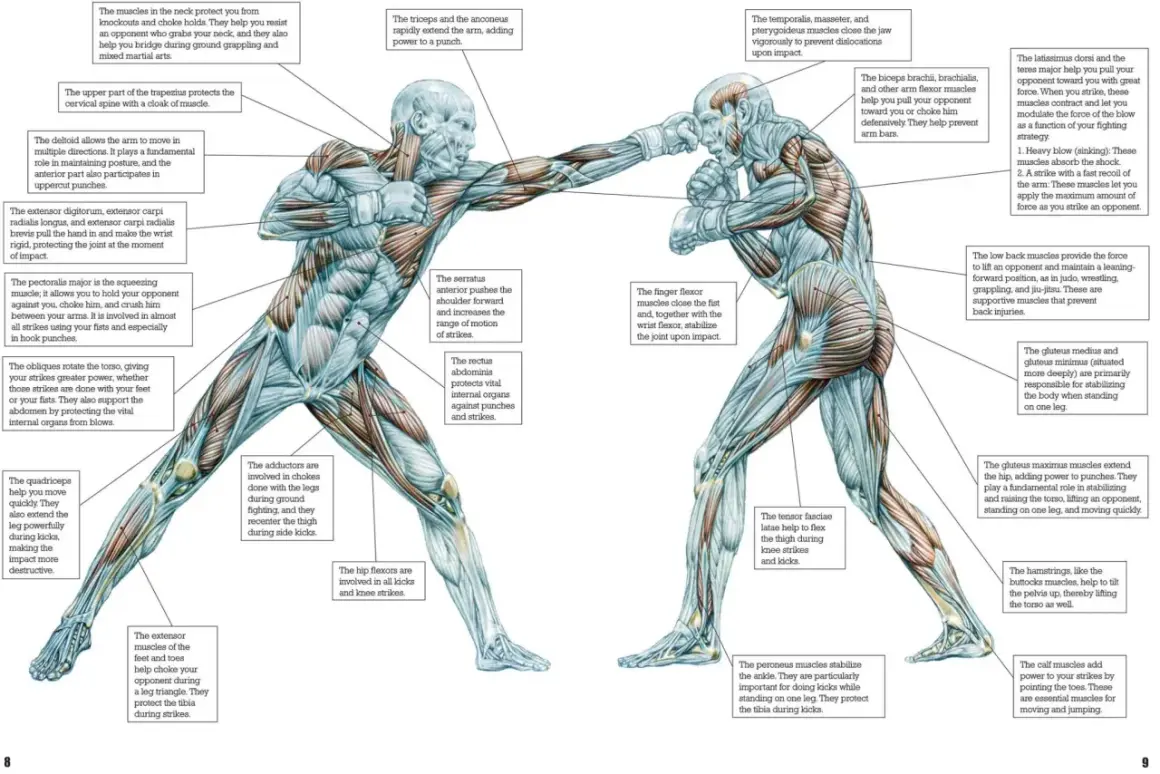
The strongest punches come from a full-body chain, not isolated arm work
- Legs and hips create the base force that starts the punch.
- Core muscles transfer that force without energy leaks.
- Shoulders, chest, triceps, lats, and forearms deliver and stabilize the strike.
- Technique matters as much as strength, because better sequencing can beat bigger muscles.
- Explosive, low-volume training usually transfers better than endless bodybuilding volume.
How punching power actually travels through the body
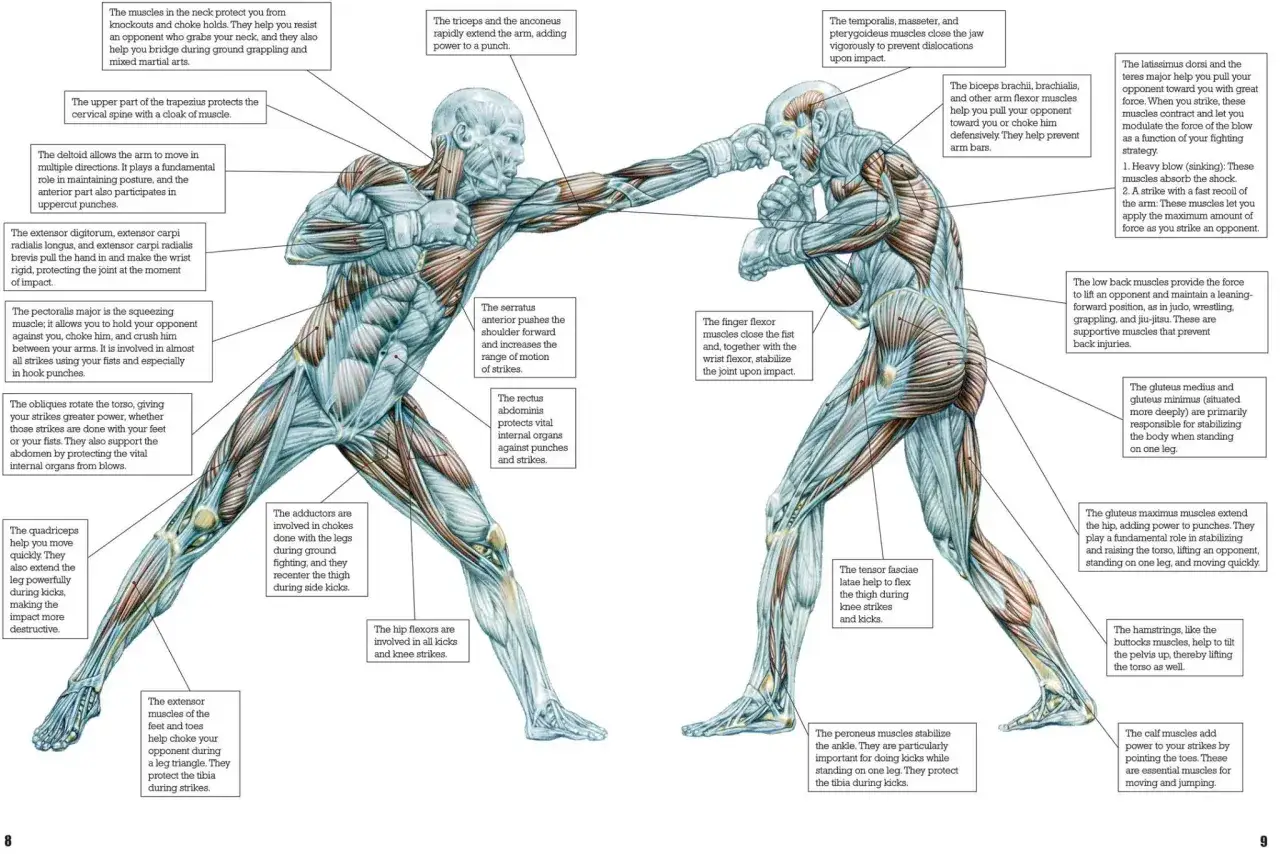
I look at punching power as a chain, not a single-muscle problem. Force is created against the floor, organized by the lower body, transmitted through the trunk, and released through the arm. That is why a smaller fighter with cleaner sequencing can often hit harder than a stronger lifter who only trains presses.Biomechanics research keeps pointing in the same direction: the best punchers are better at sequencing body segments and creating what coaches often call effective mass, which is the part of the body that is actually braced and moving with the strike at impact. In plain English, your punch is harder when your body behaves like one connected unit instead of a loose collection of moving parts.
| Phase | Main muscle groups | What they do |
|---|---|---|
| Ground drive | Glutes, quads, hamstrings, calves | Create force against the floor and stabilize your stance |
| Rotation | Glutes, obliques, adductors, spinal erectors | Turn the hips and trunk without leaking force |
| Delivery | Deltoids, serratus anterior, lats, pecs, triceps, forearms | Project the fist and keep the shoulder and wrist lined up |
That chain explains why I rarely chase arm strength first. The arm matters, but it is usually the last link, not the engine. From here, the next question is obvious: which muscles at the bottom of the chain matter most?
The lower-body muscles that create the base
If I had to pick the most important muscle groups for harder punches, I would start below the waist. Recent boxing studies show that lower-body strength is more closely tied to punch force than upper-body strength alone, which matches what coaches see every day: the legs and hips decide whether a punch has real drive behind it.
| Muscle group | What it contributes | Practical note |
|---|---|---|
| Glutes | Hip extension and rotation | They are a major power source on crosses, hooks, and exits. |
| Quads | Knee drive and stance support | They help you push, settle, and change level without collapsing. |
| Hamstrings | Hip control and force transfer | They help stabilize the back leg and support rapid recoil. |
| Calves | Short, explosive push and balance | They matter more than people think for rhythm, bounce, and pivoting. |
| Adductors and hip stabilizers | Control of the stance and leg alignment | They keep power from leaking when you rotate hard off the floor. |
The rear leg usually does the heavy pushing on straight shots, while the lead leg helps with balance, braking, and pivoting on hooks and angle changes. If the hips cannot turn fast and the legs cannot stay rooted, the punch becomes arm-dominant very quickly. That sets up the next piece of the puzzle: the trunk has to connect all of this without collapsing.
The core muscles that transfer force without leaking it
The core is not there to crunch every punch into existence. Its real job is to connect the lower body to the upper body, keep the ribs and pelvis organized, and create enough stiffness that force does not disappear before it reaches the glove. I want the trunk to be stable enough to transmit power, but not so rigid that rotation gets blocked.
Brace first, then rotate
The obliques do a lot of the visible work in punching because they help rotate and control rotation. The transverse abdominis, rectus abdominis, and deep stabilizers help keep pressure through the torso so the spine does not fold under load. If your midsection feels sloppy when you punch, the problem is usually not a lack of abs. It is a lack of coordinated stiffness.The lower back keeps the punch from folding
The erector spinae and multifidi help hold posture when you load, pivot, and absorb force. They are not glamorous muscles, but they matter when you are tired and your mechanics start to drift. A lot of punches lose authority late in rounds because the trunk softens first, and once that happens the shoulders have to do too much work.
Put simply, a strong core does not just make you harder to knock off balance. It makes the rest of your strike land with more of your body behind it. From there, the upper body has a much smaller but still essential job to do.
The upper-body muscles that finish and protect the strike
The arms do not generate most of the power, but they do finish the job. They accelerate the hand, guide the path, and protect the joints so the force you built below the waist actually reaches the target. I think of the upper body as the delivery system.
| Muscle group | Main job in a punch | Why it matters |
|---|---|---|
| Deltoids | Start and guide the arm path | They help the shoulder move efficiently without losing position. |
| Pectorals | Assist horizontal drive | They matter most on straight punches and tight, forceful pushes. |
| Triceps | Elbow extension | They finish the straight punch and help you snap the arm back. |
| Lats | Shoulder control and recoil | They help with braking, recovery, and keeping the shoulder packed. |
| Serratus anterior | Scapular control and reach | It keeps the shoulder blade moving cleanly so the punch stays efficient. |
| Forearms and rotator cuff | Wrist and shoulder stability | They keep the fist lined up and the shoulder joint safer under impact. |
I would not overrate the biceps here. They help with control and recovery, but they are not the main engines of punch force. A huge pressing day can make your upper body strong, yet still leave your punches disconnected if the hips and trunk are not doing their share. That is why the next section matters more than any single lift.
How I would train punching power in conditioning work
If the goal is harder punches, I want three things in training: more force from the lower body, better force transfer through the trunk, and faster delivery through the upper body. The mistake most fighters make is chasing fatigue too early. Power work should feel crisp, fast, and technically clean.
Build strength where force starts
I would anchor the week with lower-body strength work that respects fight weight and recovery. Good options include trap-bar deadlifts, front squats, rear-foot elevated split squats, Romanian deadlifts, and step-ups. For most fighters, 3 to 5 sets of 3 to 5 reps is enough to build force without turning the session into slow grinding.
Turn strength into speed
Once the base is there, I would use medicine ball throws, scoop tosses, rotational slams, jump variations, and landmine punches to teach force to move fast. Here the rep ranges stay small: usually 3 to 6 sets of 3 to 5 explosive reps. If the speed drops, I stop the set. Once power turns into survival, the benefit changes.
Read Also: Toned Arms for Women - Real Results, No Gimmicks
Condition the pattern, not just the lungs
For punch-specific conditioning, I like short bursts that force good mechanics under stress. That can mean bag intervals, pad flurries, shadowboxing sprints, or circuit work that alternates rotation, footwork, and brief rest. Two focused power sessions per week is enough for many fighters if technical work is already high. I would rather see quality repeated often than see one huge session that ruins the next two days.
- Lower-body strength: 1 to 2 exercises, 3 to 5 hard sets
- Rotational power: 2 to 4 drills, low reps, full speed
- Punching intervals: short rounds with enough rest to keep form sharp
- Easy aerobic work: useful for recovery between bursts and rounds
That combination builds punch force without flattening speed. It also makes the body more resilient when the round gets messy, which is where many power programs fall apart.
The mistakes that make punches look strong but land soft
Most weak punching programs do not fail because they lack effort. They fail because they train the wrong quality. I see the same mistakes over and over: too much arm work, too much fatigue, and too little attention to how force moves through the body.
| Mistake | What it costs | Better move |
|---|---|---|
| Chasing chest and arm size only | You build pressing strength without real strike transfer | Prioritize legs, hips, trunk rotation, and full-chain work |
| Training power when already exhausted | Speed drops and mechanics get sloppy | Do explosive work early, while output is still high |
| Neglecting foot pivot and hip turn | Force stays trapped in the upper body | Practice stance, pivot, and rear-leg drive on every major punch |
| Tensing too early | The punch becomes stiff and slow | Stay loose until the final fraction of the strike |
| Ignoring deceleration muscles | Shoulders and elbows take unnecessary stress | Train lats, rotator cuff, and trunk stability as part of conditioning |
A punch can feel heavy in the gym and still land light in live work if the chain is broken. The better test is whether your mechanics stay sharp when you have to repeat the same action under pressure. That leads to the final question: what happens when fatigue shows up in the later rounds?
What holds the chain together when fatigue sets in
Fatigue does not just make you tired; it changes which muscles take over. When a fighter gets tired, the legs stop driving as well, the trunk softens, and the shoulders start doing too much of the work. At that point, punches become more arm-like and less connected, even if the athlete still feels aggressive.
- Keep power intervals short enough that technique does not collapse.
- Use easy aerobic work so recovery between exchanges gets better.
- Practice repeated bursts, not just one all-out flurry.
- Stop a set the moment the punch starts turning into a push.
If I were building harder punches from scratch, I would prioritize leg drive, trunk stiffness, and rotational speed before I obsessed over arms. Then I would layer in shoulder and forearm work to finish the strike cleanly and keep the joints intact. That order matches how force actually moves, and it is the most reliable way to make punches feel heavier without making them slower.