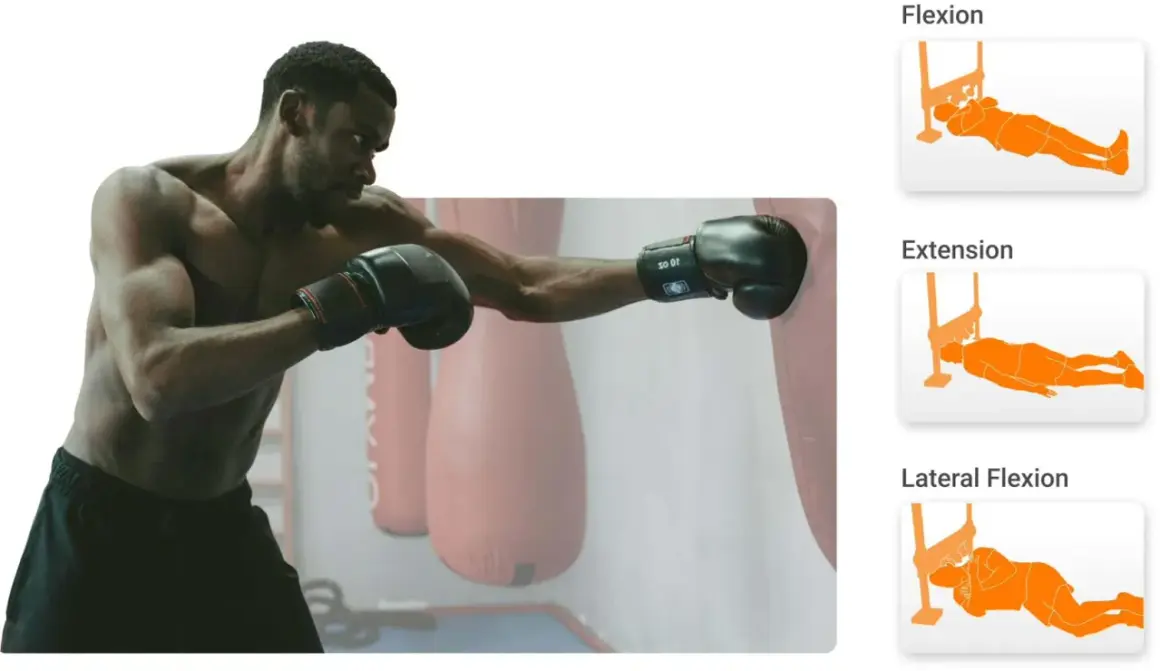
A strong neck changes how a fighter absorbs contact, holds posture in the clinch, and stays organized when the head gets snapped, pulled, or pressured off line. MMA neck training works best when it is treated as a small, repeatable part of conditioning, not a brutal one-off exercise. In this article I break down which exercises actually matter, how hard to train them, how to slot them into a fight camp, and where the real risks usually show up.
What matters most when you train the neck for MMA
- Isometrics are the safest starting point and the easiest to recover from.
- Dynamic work builds usable strength, but the load has to progress slowly.
- Neck bridges are optional, not mandatory, and they are not the first drill I would give a beginner.
- Two to three sessions per week is enough for most fighters in development phases.
- If a session creates pain, dizziness, or radiating symptoms, stop and get it checked.
Why neck strength matters in MMA
The neck is not a vanity muscle in fighting. It helps stabilize the head when you are hit, pulled, snapped down, or forced into bad angles in the clinch. Recent review work in PubMed points to isometric neck strength as more meaningful than neck size for lowering head-impact risk, but I would treat that as a performance and resilience advantage, not a promise that injuries disappear.
In practical terms, the goal is better head control, less post-contact wobble, and more tolerance for the constant small forces that happen in grappling. A fighter with a stronger neck usually looks a little harder to move, a little less rattled after contact, and a little more stable when posture gets broken. That does not replace defense, timing, or positioning, but it does buy you a margin. That is why the next question is not whether to train the neck, but which methods are worth the time.
The safest ways to build a stronger neck
I usually start with the least aggressive options and earn the right to load the neck harder. The best method depends on the athlete’s training age, history of neck issues, and how close they are to hard sparring. In most cases, the smartest path is: control first, isometrics second, then controlled dynamic loading.
| Method | Best for | Why it works | Watch-outs |
|---|---|---|---|
| Isometric holds | Beginners, in-camp maintenance, fighters returning from a layoff | Easy to dose, easy to recover from, and good for building bracing skill | Can become too easy if you never progress the angle, duration, or resistance |
| Manual resistance or partner work | Sports-specific control and quick direction changes | Gives immediate feedback and trains the neck to resist movement in multiple directions | Force is harder to standardize, so sloppy partners can turn it into guesswork |
| Harness or cable loading | Strength and local muscular endurance | Makes progression easy to track and lets you overload in a controlled way | Load jumps too fast if you chase numbers instead of clean reps |
| Dynamic flexion and extension | Full-range strength and movement under tension | Useful when posture changes quickly in scrambles and clinch exchanges | Keep the tempo slow; jerky reps are where irritation shows up |
| Neck bridges | Advanced wrestlers and experienced fighters with a solid base | Can challenge positions that other drills do not touch | Higher compressive and extension demand, so I would not use them as a foundation exercise |
Neck bridges can have a place, but I would keep them optional. They are not the magic solution people sometimes make them out to be, and they are easy to overdo if the athlete is already getting hammered by wrestling and sparring. If you use them, keep the range small, the reps low, and the technique strict. Once the method is chosen, the real value comes from dose and progression.
A practical neck routine you can plug into camp
A good session should fit inside 10 to 15 minutes and leave the neck worked, not wrecked. I prefer to start with control, move to isometrics, and finish with light dynamic work. That order builds tolerance without making the neck the limiting factor for the rest of training.
A simple starter session
- Chin tucks or nods: 2 sets of 6 slow reps
- Isometric flexion, extension, left side bend, right side bend: 2 to 3 sets of 10 to 20 seconds each direction
- Light band or harness flexion and extension: 2 sets of 8 to 12 controlled reps
- Optional suitcase carry or farmer carry: 2 sets of 20 to 40 meters to reinforce trunk and shoulder support
Read Also: Boxing Mental Conditioning - Master the Mind for Victory
How I would progress it
- Add time before adding load. Going from 10-second holds to 15-second holds is usually cleaner than jumping straight to heavy resistance.
- Only add load when the chin stays organized and the next day does not feel stiff or cranky.
- Use 2 sessions per week as a baseline in-season, and 3 sessions per week if the fighter is in a building phase.
- Keep the effort submaximal if hard sparring is close. Neck work should support camp, not drain it.
The main cue I use is simple: if the head starts jutting forward, the ribs flare hard, or the athlete loses clean control, the set is too heavy or too long. The routine is simple, but the mistakes are just as common, and they are usually what make fighters abandon the work.
Common mistakes that stall progress or irritate the cervical spine
- Training only extension and ignoring flexion and lateral flexion. The neck needs balance, not just a strong rear chain.
- Chasing fatigue instead of quality. Once form gets sloppy, you are no longer training useful control.
- Jumping straight to bridges or heavy resisted rotations. Those tools make more sense after the athlete has built tolerance with simpler work.
- Doing hard neck work right before the highest-risk rounds. That turns preparation into warm-up fatigue.
- Treating soreness as success. Mild local work is normal; lingering pain, headaches, or stiffness that affects grappling is not.
- Ignoring the upper back and scapulae. Neck training lands better when the shoulders, thoracic spine, and trunk are doing their part.
If a fighter gets numbness, tingling, dizziness, unusual headaches, or pain that radiates into the arm, I would stop the session and get it assessed. That is not the same thing as normal training fatigue. Once those errors are removed, the next step is periodization, because the same plan should not look identical in the off-season and during a hard camp.
How to periodize neck work across a fight camp
The biggest mistake I see is using the same neck session all year. Fighters do not have the same recovery budget in January that they have during the last two hard sparring weeks before a bout. The work should match the phase of training.
- Off-season: 2 to 3 sessions per week, mix isometric and dynamic work, and build capacity gradually.
- Pre-camp: 2 sessions per week, keep the quality high, and start respecting the fatigue cost of wrestling and striking volume.
- Hard sparring weeks: 1 to 2 short sessions per week, mostly isometric with light dynamic work, and avoid chasing a pump.
- Fight week: only activation-style micro-sessions if the athlete tolerates them well, with no soreness as the goal.
I also like to place neck work after lifting or technical work, or at the end of a lighter practice. I rarely want it before the hardest live wrestling rounds unless the goal is a very light activation. That approach keeps the neck work as support work, which is where it belongs, and it frees up the final question: what is actually worth keeping when the camp gets messy?
The version of neck training that survives a real fight camp
If I had to strip the whole subject down to one rule, I would make the neck stronger by degrees, not by heroics. Build the front, back, and sides; start with isometrics; add controlled resistance second; and let the goal be better head control in the clinch, safer posture under pressure, and less fatigue after contact. The best plan is the one a fighter can keep doing without sparring quality dropping.
That usually means a modest weekly dose, clean execution, and a willingness to back off when the neck is already carrying enough stress from wrestling, striking, and grappling. In real MMA prep, the neck is not a separate project. It is part of the athlete’s base, and when it is trained well, everything around it tends to look a little more stable.