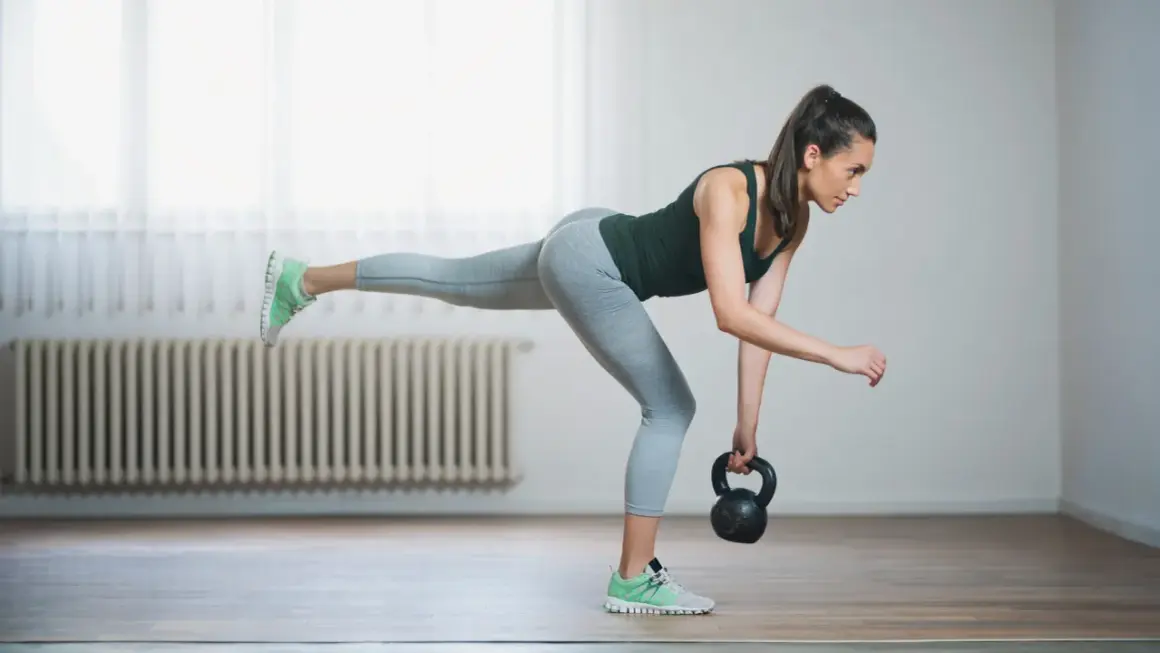
Kettlebell balance exercises are useful when you want strength that carries over to real movement: cutting, bracing, carrying, and staying organized under fatigue. In practice, I use them to build the kind of control that shows up in sport, in conditioning blocks, and even in simple tasks like picking up awkward objects without twisting or collapsing. This guide breaks down which drills work best, how to program them, the mistakes that limit progress, and how to turn them into a short session you can actually repeat.
The fastest way to build better balance is to load position, not chase wobble
- Balance improves most when the load is offset, unilateral, or carried in a position that forces you to stay stacked.
- Best starters are suitcase carries, front-rack carries, split squats, single-leg deadlifts, and Turkish get-ups.
- Train 2 to 3 times per week for 15 to 25 minutes if the goal is conditioning with control.
- Keep the reps clean; stop before your rib cage flares, your foot collapses, or you start leaning.
- Progress gradually by adding distance, time, overhead positions, or slower tempo instead of just loading heavier.
- Stable ground matters; you do not need unstable surfaces to make balance work effective.
What kettlebell balance training actually develops
When I talk about balance, I am not talking about standing on one leg and hoping for the best. Real balance is a stack of skills: foot pressure, ankle control, hip stability, trunk position, breathing, and the ability to resist rotation when the load shifts away from the centerline. A kettlebell is useful because its shape forces that conversation immediately.
The offset handle changes where the load wants to pull you. That means your body has to respond in a more honest way than it does with many machine-based exercises. The foot has to grip the floor, the hip has to keep the pelvis level, and the trunk has to resist tipping or twisting. That is why these drills are so effective for conditioning: they tax stability without needing endless volume.
I also like kettlebells because they let you train two different kinds of balance at once:
- Static control, where you hold a position without drifting.
- Dynamic control, where you move from one position to another without losing alignment.
That distinction matters. A lot of people get decent at holding a pose, then fall apart the moment they step, hinge, or press. The best carryover comes from training both. Once that is clear, the next step is choosing the drills that give you the most return.
The drills I rely on for stability and why they work
Not every kettlebell movement deserves a place in a balance-focused program. I keep coming back to the same handful because they solve different problems: sideways collapse, trunk rotation, single-leg control, overhead stability, and shoulder positioning. The table below shows the ones I would start with.
| Exercise | What it builds | Why it matters | Best coaching cue |
|---|---|---|---|
| Suitcase carry | Lateral trunk stability, hip control, grip | Teaches you not to lean when the load is on one side | Stay tall and keep both hip bones level |
| Front-rack carry | Core bracing, upper-back posture, rib control | Challenges the body without needing fast movement | Keep the bell close and the ribs stacked over the pelvis |
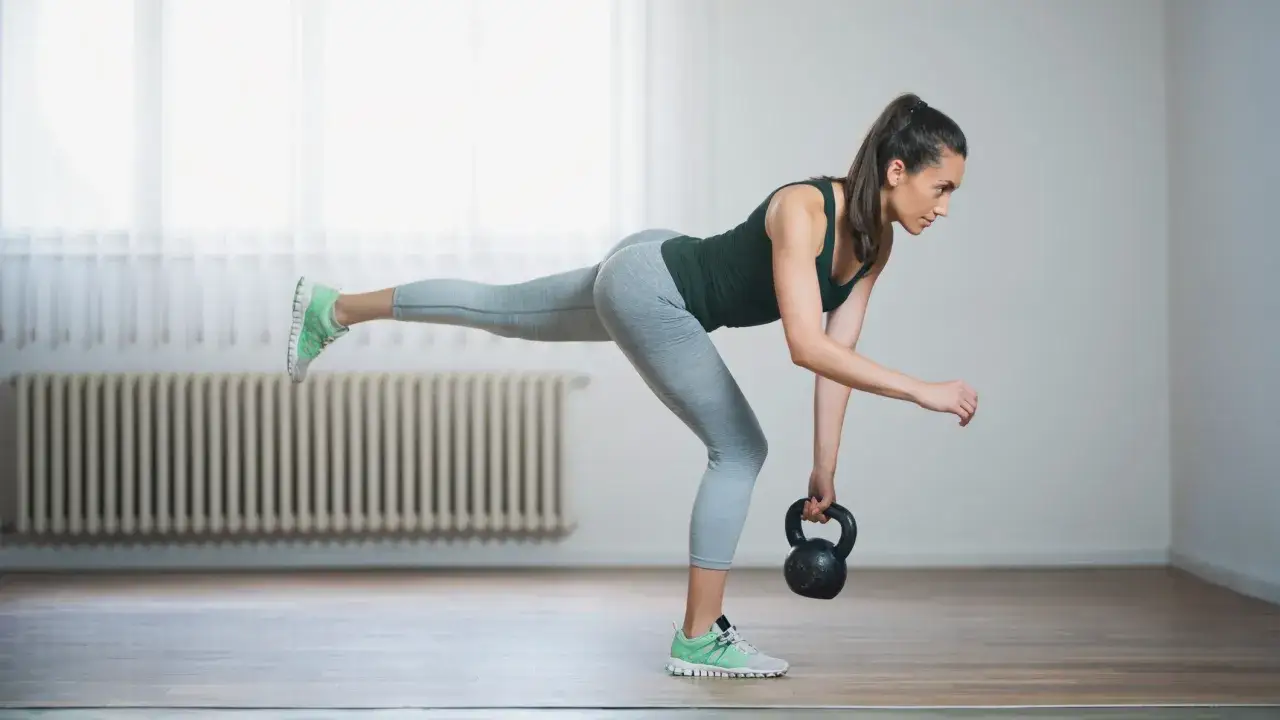
| Single-leg deadlift | Hinge control, hip stability, foot awareness | Shows whether the pelvis stays square under load | Reach the free leg long instead of twisting open |
| Split squat or reverse lunge | Pelvic control, knee tracking, stance stability | Useful for athletes and anyone who needs better directional control | Descend quietly and keep pressure through the whole foot |
| Turkish get-up | Full-body integration, shoulder stability, floor-to-stand control | Probably the best all-around test of usable stability | Move slowly enough that every transition stays deliberate |
| Bottoms-up press or carry | Grip, shoulder centration, fine motor control | Small mistakes become obvious fast, which makes it a strong teaching tool | Stack wrist, elbow, and shoulder in one line |
If I had to simplify the list even more, I would start with a carry, a single-leg hinge, and one overhead drill. That combination covers most of the control problems people actually have. The get-up is valuable too, but it is better as a skill to earn than as a movement to rush.
How to program them for conditioning without losing control
The biggest mistake I see is turning balance work into sloppy conditioning. The point is not to be exhausted first and stable second. The point is to stay organized while the work density rises. That is a different demand, and it needs different rules.
| Training goal | Frequency | Work style | Useful dose | Rest |
|---|---|---|---|---|
| Skill and control | 2 sessions per week | Low-to-moderate volume | 2 to 3 exercises, 2 to 3 sets, 3 to 5 reps per side or 20 to 30 meters per carry | 60 to 90 seconds |
| Conditioning focus | 2 to 3 sessions per week | Circuit or alternating sets | 3 to 5 exercises, 2 to 4 rounds, 5 to 8 reps per side or 30 to 45 seconds of work | 30 to 60 seconds |
| Advanced carryover | 1 to 2 sessions per week | Longer carries and more demanding positions | 30 to 40 meters, slower tempo, or overhead work if positions stay clean | 90 seconds or more |
For most people, 2 to 3 sessions per week is enough. That is frequent enough to improve motor control without beating up your grip, shoulders, or lower back. If you are also doing hard lifting, sprint work, or combat-sport practice, keep these sessions short and place them where they will not compete with the main goal of the day.
My rule is simple: if your breathing is hard but your positions are still crisp, you are in the right zone. If your foot arches collapse, your ribs flare, or your torso starts drifting with every rep, the set is too long or the weight is too heavy.
The mistakes that steal balance gains
Balance work is unforgiving in a useful way. Small technical errors show up quickly, and if you ignore them, the exercise turns into compensation practice. These are the mistakes I correct most often.
- Going too heavy too soon - the load should challenge your position, not force you to survive it. If you cannot keep the pelvis level, the bell is too heavy for the drill.
- Rushing the movement - speed hides problems. Slow reps expose them, and that is what you want when the goal is stability.
- Letting the ribs flare - once the rib cage opens, the trunk loses its stack and the lower back usually picks up the slack.
- Ignoring the foot - balance starts at the floor. A flat, stable base usually gives better results than fancy variations on soft surfaces.
- Using unstable tools too early - wobble boards and similar tricks are not a shortcut. Most people still need better control on stable ground first.
- Forgetting to breathe - a hard brace is not the same as holding your breath for the whole set. Short, controlled exhales help keep tension where it belongs.
One detail I care about more than most people expect is footwear. A flat, stable shoe usually works better than a soft running shoe because it lets the foot spread and grip the floor. Barefoot work can also be useful when the setting is safe and controlled. Once those errors are cleaned up, the program starts to feel a lot more productive.
A 15-minute session you can run this week
When I want a simple conditioning block that still respects control, I like a short circuit built around carries and unilateral patterns. It is long enough to work, short enough to repeat, and specific enough to expose weaknesses without turning into a generic sweat session.
- Warm up for 3 minutes with hip hinges, bodyweight reverse lunges, and a few slow halos to wake up the shoulders.
- Suitcase carry - 2 rounds of 20 to 30 meters per side. Rest 30 to 45 seconds between sides.
- Single-leg deadlift - 2 rounds of 5 reps per side with a slow lowering phase.
- Front-rack reverse lunge - 2 rounds of 6 reps per side, staying tall through the torso.
- Bottoms-up hold or press - 2 rounds of 15 to 20 seconds per side, or 4 to 5 controlled presses if the position is solid.
- Finish with one Turkish get-up per side if you still feel crisp, not rushed.
This format works because it alternates stress. Carries challenge the trunk and grip, hinges challenge the hips, lunges challenge the pelvis and knee control, and the overhead work checks whether the shoulder can stay centered under tension. If you feel the sequence falling apart, do not add more exercises. Shorten the circuit, keep the quality, and build from there.
How to make the work carry over to sport and daily movement
The reason these drills matter to me is not just that they look athletic. They help you handle asymmetry. That matters in combat sports when you are managing stance shifts, clinch pressure, and explosive directional changes. It also matters outside the gym when you carry bags, climb stairs, or recover from a misstep without compensating through the lower back.
If you train for sport, I would keep most stability work after the main strength block or on a separate day from hard technical sessions. That keeps the nervous system fresh for skill practice. If you train mainly for general conditioning, you can place it in the middle of a workout as long as your technique stays honest.
The cleanest progression is not always heavier weight. Sometimes the next step is a longer carry, a slower descent, a tighter rack position, or moving from a two-leg drill to a split stance. Once those are easy, then the overhead variations and the get-up become more useful.
If you treat these drills as skill work rather than random fatigue, kettlebell balance exercises become one of the cleanest ways to build usable stability. Start with carries and split-stance patterns, keep the reps controlled, and earn the more complex positions only when the simpler ones stay solid.