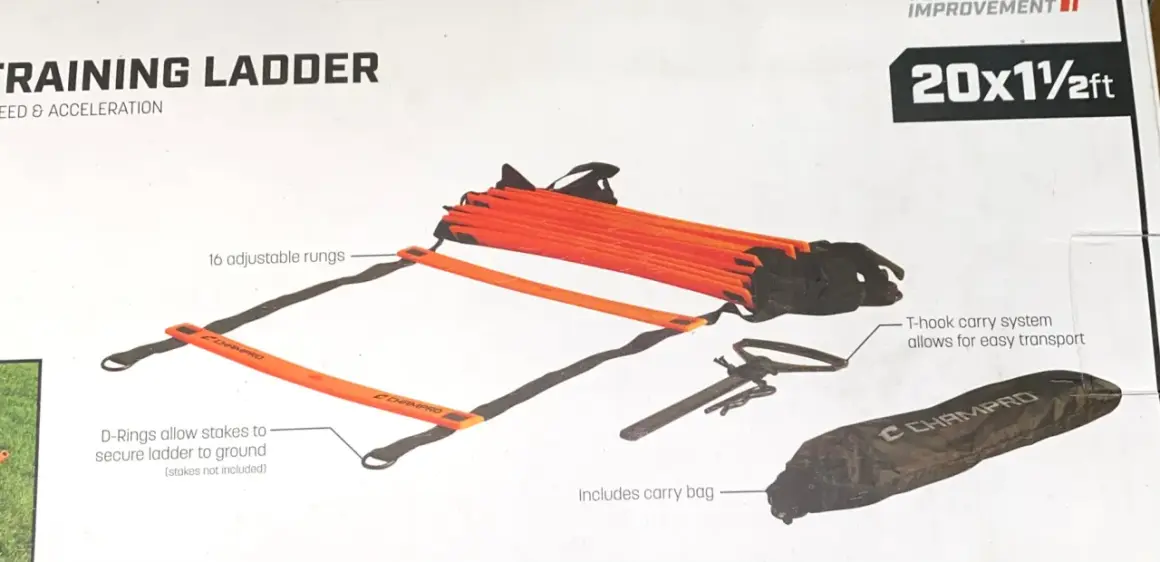
Agility ladder work is one of the simplest ways to sharpen foot placement, rhythm, and coordination without turning every conditioning block into a collision. The value is real, but narrow: it can improve how fast and cleanly you organize your feet, yet it does not replace sprinting, braking, or reactive change-of-direction work. In this article I break down what the tool develops, which patterns are worth using, how I would program it, and where it starts to lose carryover.
Key points for using the ladder well
- Use it for coordination first. Fast feet matter, but clean contacts and stable posture matter more.
- Keep the reps short. Once the feet get noisy or the torso starts swaying, the set has already done its job.
- Treat it as a conditioning accessory. It can raise heart rate, but it should not replace sprinting or sport-specific intervals.
- Pick patterns with a purpose. Forward, lateral, and crossover work each train a different piece of footwork.
- Pair it with transfer work. Shuttles, shadowboxing, deceleration, and reactive cues make the session much more useful.
What this tool actually trains
When I use a ladder, I am mainly chasing coordination under tempo. The athlete has to place the feet quickly, keep the posture organized, and recover the stance without looking frantic. That makes it useful as a bridge between warm-up and harder work, especially for combat athletes who need the lower body busy while the upper body stays relaxed.
The important distinction is this: a ladder trains planned movement, not true reactive agility. Real agility depends on reacting to an opponent, a cue, or a change in space. The ladder can improve the mechanics that support that skill, but it cannot fully replace it.
| Quality | What ladder work can improve | What still needs another drill |
|---|---|---|
| Foot cadence | Quicker step timing and cleaner rhythm | Max sprint speed and acceleration |
| Stance control | Faster reset after each contact | Hard braking and deceleration |
| Coordination | Better arm-leg timing and foot placement | Decision-making under pressure |
| Conditioning | Short bursts that raise heart rate quickly | Fight rounds, shuttles, or sprint intervals |
That is why I never sell it as a magic speed fix. I treat it as a movement-quality tool that also adds a small conditioning hit, and that leads straight into where it fits in a session.
Where it fits in conditioning
I treat it as a short-burst conditioning tool, not a stand-alone engine. That makes it fit cleanly in three places: as a neural warm-up before sparring or lifting, as a brief finisher after skill work, or as a low-cost option when space is tight and I still want the athlete moving at a good clip.
| Use case | Work and rest | Typical volume | Why it fits |
|---|---|---|---|
| Warm-up | 10 to 15 seconds on, 20 to 30 seconds off | 4 to 6 minutes | Primes the feet without draining the session |
| Finisher | 15 to 20 seconds on, 15 to 30 seconds off | 6 to 10 minutes | Raises heart rate while mechanics are still fresh enough to stay clean |
| Main conditioning block | 20 seconds on, 20 to 40 seconds off | 10 to 15 minutes | Useful only if the athlete already has bigger sprint or sport rounds elsewhere |
If I already have hard sparring, bag intervals, or sprint work on the same day, I keep ladder volume modest. The goal is to support conditioning, not pile on so much extra work that the feet turn sloppy and the session becomes junk volume.
Patterns worth keeping and what they do
Not every pattern deserves space. I keep the ones that train a clear quality and cut the flashy sequences that look busy but do not challenge anything specific. If a pattern does not improve cadence, stance control, or lateral repositioning, I usually leave it out.
| Pattern | Main benefit | Best cue | Common mistake |
|---|---|---|---|
| Two feet in each square | Quick rhythm and repeatable contacts | Stay low and quiet | Landing too hard and bouncing upright |
| In-in-out-out | Lateral control and hip organization | Drive from the hips, not just the feet | Crossing the feet and losing stance width |
| Ickey shuffle | Contralateral timing and coordination | Let the opposite arm and leg work together | Rushing the second step and clipping the ladder |
| Lateral crossover | Hip rotation and side-to-side flow | Rotate from the hips, not the torso | Twisting the chest and losing balance |
| Single-leg hop through | Ankle stiffness and balance | Own each landing | Over-hopping and turning it into a pogo contest |
| Forward run and retreat | Stance recovery after speed | Reset quickly after each pass | Standing too tall between contacts |
For most athletes, three or four patterns in one session is enough. More variety usually reduces quality before it adds benefit, and I would rather see a clean two-minute block than a messy ten-minute circus.
How I would program a session
Programming is where most people either underdose the work or turn it into a dance routine. My rule is simple: the set ends when speed drops, the feet get noisy, or posture starts leaking; extra volume after that is just sloppy rehearsal.
| Athlete level | Sample block | Total time | Why it works |
|---|---|---|---|
| Beginner | 4 patterns, 2 rounds, 15 seconds on, 45 seconds off | 8 to 10 minutes | Enough exposure to learn the rhythm without panic or form collapse |
| Intermediate | 5 patterns, 2 to 3 rounds, 20 seconds on, 20 to 30 seconds off | 12 to 15 minutes | Enough density to feel like conditioning while the mechanics stay usable |
| Combat-sport finisher | 4 patterns, 6 to 8 rounds, 15 seconds on, 15 to 20 seconds off | 8 to 12 minutes | Sharp, repeatable fatigue that still leaves room for stance and movement quality |
I usually place this work two to three times per week at most, and often less if the athlete already has a lot of sprint or sparring volume. If the head starts bobbing, the hips rise, or the steps stop sounding crisp, the session is done. That simple cutoff keeps the ladder useful instead of decorative.
Common mistakes that waste the session
The common mistakes are predictable, and almost all of them come from chasing speed before control.- Going too long - after 60 to 90 seconds, quality often drops unless the athlete is very well trained.
- Looking busy instead of moving well - fast hands and noisy contacts do not equal better footwork.
- Staying too upright - a tall torso makes the sequence slower and less useful for sport.
- Ignoring the exit - the way you leave the ladder matters more than the last square.
- Using only forward patterns - most sports ask for lateral or angled movement, not just straight-line rhythm.
- Replacing real agility work - without reactive cuts and deceleration, carryover stays limited.
Those mistakes matter because the ladder should support sport movement, not hide the lack of it, and that is exactly why the next step is pairing it with work that forces transfer.
What I pair it with for better carryover
If I want better carryover, I pair the ladder with movements that solve the parts it cannot train on its own.
- Sprints or short shuttles - these add acceleration and braking, which the ladder never truly tests.
- Reactive callouts - partner cues or numbers force decision-making instead of pre-planned footwork.
- Shadowboxing or bag rounds - for fighters, this keeps the feet tied to stance, distance, and strike entry.
- Plyometrics - low-volume jumps help if the athlete needs more elastic power, not just cadence.
- Deceleration drills - a hard stop, stick, or angle exit teaches the body to absorb force cleanly.
For combat athletes, a simple blend works well: 15 seconds on the ladder, 20 seconds of stance movement or shadowboxing, then 30 seconds of rest, repeated 6 to 8 times. That keeps the tempo high while tying the footwork to the positions you actually use in a round.
Where the ladder earns its place in a serious session
Used this way, ladder drills are not the hero of conditioning; they are the sharp, repeatable piece that makes the rest of the session cleaner. If you keep the tempo high, the contacts quiet, and the carryover honest, the ladder earns its place.