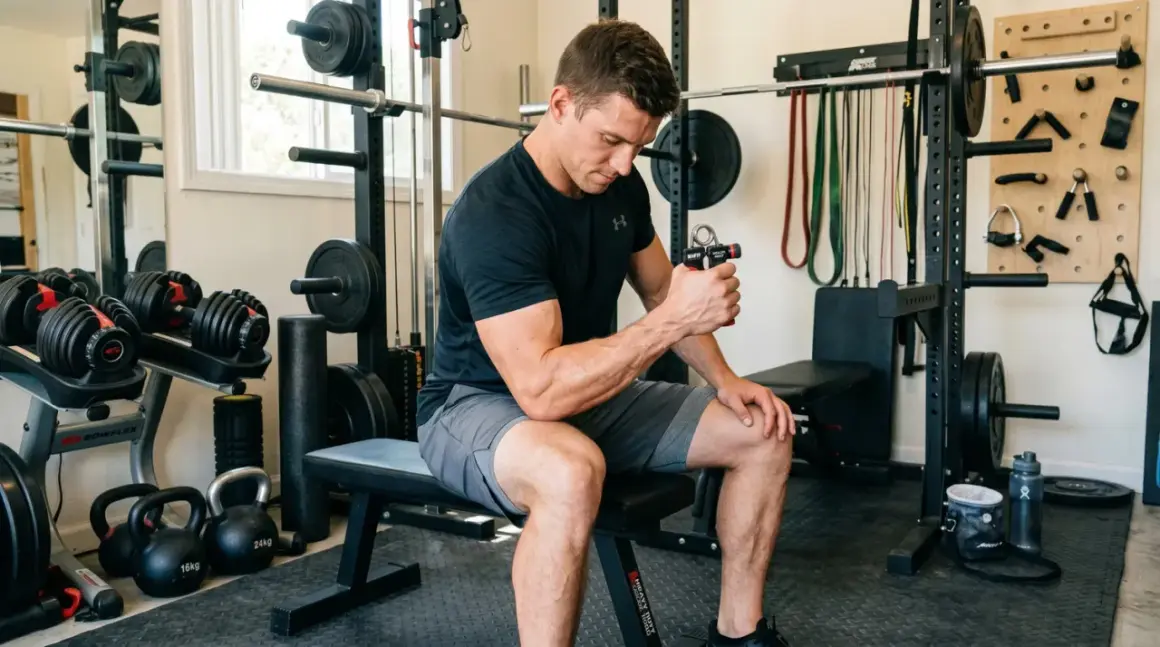
Grippers look simple, but they can be a useful accessory when the goal is stronger forearms, better grip endurance, and more control under load. I treat hand grippers for forearms as a targeted tool, not a complete forearm plan, because they mainly train the closing side of the hand and wrist. That makes them relevant for lifting, grappling, carrying, climbing, and any kind of work where your grip fails before the rest of you does.
The short version is that grippers help most when you want closing strength that can repeat
- They mainly train crush grip, which is the squeezing force that closes the hand around an object.
- They do not cover the whole forearm, so support grip, pinch grip, and wrist extensors still need separate work.
- A good starting point is 2 to 4 sessions per week with 2 to 4 hard sets per hand.
- For strength, use 3 to 8 controlled reps; for conditioning, use 10 to 30 second holds or higher-rep sets.
- If you can close a gripper for 20 or more clean reps, it is probably too light for useful training.
- The best results come when grippers are paired with carries, hangs, and extensor work.
What grippers actually build and what they miss
The forearm is not one muscle. It is a system of flexors, extensors, and stabilizers that control the wrist, fingers, and thumb. Grippers mainly load the muscles that close the hand, so they are excellent for crush grip and useful for local fatigue resistance, but they do not fully train the rest of the chain.
That distinction matters because a lot of athletes confuse grip strength with a single number. In practice, I separate it into three useful buckets: crush grip, support grip, and pinch grip. Grippers are best at the first one, partially helpful for the second, and only a weak substitute for the third.
| Grip or forearm quality | What grippers do well | What you still need |
|---|---|---|
| Crush grip | Directly trains closing force and squeeze endurance | Mostly covered by grippers and heavy isometric holds |
| Support grip | Some carryover, especially when the hand fatigues | Farmer carries, dead hangs, towel work, rows |
| Pinch grip | Very little direct stimulus | Plate pinches, block holds, thumb-focused work |
| Wrist extensors | Almost none | Band finger opens, reverse curls, wrist extension work |
That is why I see grippers as a precision tool rather than a full forearm solution. Once you understand that boundary, programming becomes much cleaner.
How I use them for conditioning
When the goal is conditioning, I care less about one huge squeeze and more about whether the hand can keep producing force without cramping, collapsing, or irritating the elbow. I also want the work to be repeatable. That usually means clean reps, controlled tempo, and enough rest to keep the quality high.
- Warm up first. One to two minutes of opening and closing the hands, plus a few light squeezes, is enough to get blood moving.
- Keep the wrist neutral. If the wrist folds hard into flexion, the set turns messy and the load shifts away from the hand.
- Use a clear rep goal. For strength, I like 3 to 8 hard closes per hand. For endurance, I like 10 to 20 reps or 15 to 30 second isometric holds.
- Control the return. A slow eccentric, meaning the opening phase of the rep, adds more tissue stress than mindlessly snapping the gripper shut.
- Leave a little in reserve. Most sets should stop one or two reps before failure. All-out grinding every session is a fast way to annoy the elbows.
- Space the hard work. Two to four sessions per week is enough for most people. I usually keep at least 48 hours between heavy grip sessions.
If you want one simple rule, use a gripper that lets you close it for 6 to 12 solid reps. That range is heavy enough to matter, but not so heavy that every rep becomes a cheating contest. For conditioning, I like to finish with a hold or a slow negative rather than just piling on more sloppy reps.
How to choose the right gripper
The right tool depends on whether you are chasing measurable strength, beginner-friendly conditioning, or a hard finisher after your main training. I prefer tools that make progression obvious. If I cannot tell whether I improved, I am usually not set up well enough.
- Adjustable grippers are the easiest entry point. They let you find the right resistance quickly and are useful if you are still learning what a good working load feels like.
- Fixed-resistance coil grippers are better when you want repeatable testing and a clean sense of progression. They feel more consistent from session to session.
- Very heavy specialty grippers make sense only after your basic close is already strong. If you need to body English the handle shut, the load is probably too high for regular conditioning work.
- Cheap spring trainers are fine for casual use, but they often feel vague, and that makes progression harder to judge.
My practical selection test is simple: if the gripper lets you perform controlled closes in the right rep range without your shoulder shrugging, your wrist collapsing, or your hand twisting around the handle, it is close enough. If you can crush it for 20-plus clean reps, move up. If you cannot close it at all without cheating, move down.
Where grippers fit in combat sports and functional fitness
For the audience that trains combat sports or functional fitness, grippers are useful, but they should not be used blindly. The demand on the hands is specific. A fighter, grappler, or hybrid athlete needs the grip to survive fatigue, awkward angles, and repeated attempts, not just one perfect squeeze in fresh conditions.
- BJJ and wrestling. I like grippers after skill work or on separate accessory days. If you crush your forearms before sparring, your hand fighting and wrist control usually suffer.
- MMA. Moderate gripper work can help with clinch endurance and cage control, but it should never replace actual gripping under movement.
- Functional fitness. Pair grippers with carries, pull-ups, rope work, and hangs. That combination builds a grip that survives real workouts instead of just closing a device.
- Climbing. Use them carefully. Climbers already tax the fingers heavily, so grippers are usually a small accessory, not the main event.
- General strength training. They are a smart finisher after rows, deadlifts, or loaded carries, especially if your grip is always the first thing to fail.
For this kind of training, the main mistake is treating grippers like a shortcut. They are more like a final stressor that teaches the hands to stay on longer when everything else is already tired.
Mistakes that slow progress or light up the elbows
Most bad gripper training does not fail because the tool is wrong. It fails because the dose is wrong. Forearms and elbows tolerate hard work, but they do not love random volume, ugly reps, or nonstop max attempts.
- Chasing the hardest gripper too soon. If the resistance is way beyond your current level, you are practicing half-reps and compensations instead of building useful strength.
- Skipping the extensor side. If all you do is close the hand, the forearm starts to feel tight and one-sided. Band finger opens and reverse curls help balance that out.
- Training to failure every time. Occasional tests are fine. Making every set a maximal grind is usually too much for the tendons.
- Using the shoulder and torso to cheat. If the body twists to finish the squeeze, the forearm is no longer doing the job you think it is.
- Ignoring pain signals. Dull muscle fatigue is normal. Sharp elbow pain, numbness, or pain that lingers into the next day means the load or volume needs to come down.
I also think people underestimate recovery. Forearm muscles may be small, but the connective tissue around the wrist and elbow can take longer to calm down than the muscle burn suggests. That is one reason I keep most gripper work short and focused.
The smallest grip routine I would actually keep
If I wanted a simple plan that fits into a busy week, I would keep it brutally practical. One short session can cover the main bases if the exercise choices are sensible.
- Gripper closes: 2 to 3 sets of 6 to 10 reps per hand.
- Support grip: 2 sets of 20 to 40 seconds on farmer carries, dead hangs, or towel hangs.
- Extensor work: 2 sets of 15 to 25 band finger opens.
- Optional finish: 1 set of slow negatives or an isometric hold for 15 to 30 seconds.
That mix covers squeezing, holding, and balancing the wrist instead of hammering one pattern until it breaks. Used that way, hand grippers for forearms become a useful part of conditioning rather than a novelty item collecting dust in a drawer. If I had to reduce it to one idea, it would be this: build the squeeze, support it with carries or hangs, and protect it with extensor work, because that is what makes the forearms actually hold up when training gets hard.