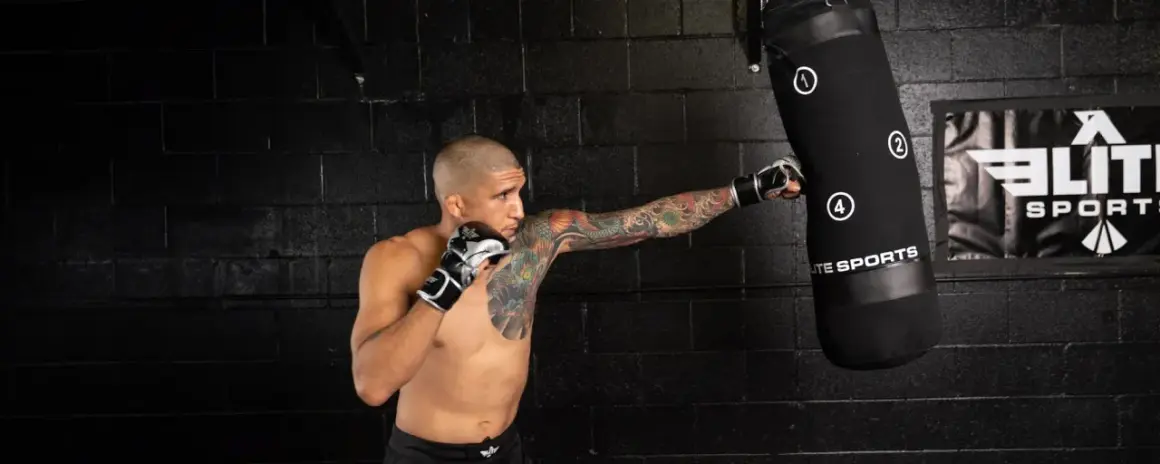
A well-built punching bag workout does more than burn calories. It sharpens your mechanics, builds boxing-specific conditioning, and gives you a repeatable way to train without needing a partner. In the article below, I break down how to structure the rounds, what technique cues matter, which gear is actually worth it, and where most people quietly sabotage their own sessions.
What to remember before round one
- Start with 5-10 minutes of movement, mobility, and light shadowboxing before you throw hard shots.
- Use timed rounds instead of random punching so the session behaves like boxing, not just cardio.
- Keep most early work at roughly 50-75% power until your form stays clean under fatigue.
- Wrap your hands and use gloves that protect the knuckles and wrist, especially if you train often.
- A good bag session should leave you tired, but your stance and guard should still look organized in the final round.
What bag work actually trains better than cardio alone
I think of bag work as a bridge between conditioning and skill. Yes, it raises your heart rate, but it also forces you to manage distance, return your hands to guard, rotate cleanly through the hips, and keep your breathing under control while you move. That is a very different demand from a treadmill or bike.
It also teaches a kind of fatigue that boxing needs: upper-body endurance with posture. When your shoulders start to burn and your legs start to feel heavy, you find out whether your stance still holds together. That matters in boxing training because sloppy mechanics under fatigue usually show up before raw fitness does.
The limitation is just as important. A heavy bag will not teach you live defense, timing against a real opponent, or the chaos of sparring. I use it as a skill-and-conditioning tool, not as a substitute for pads or ring work. Once you understand that line, it becomes much easier to train it well and avoid wasting time.
That is why I build each session around rounds and a clear purpose rather than one long blast of random punches.
How I structure a session that feels like boxing
For me, the best sessions start with a short warm-up and then move into timed rounds. I like a RAMP-style approach: raise the temperature, activate the hips and shoulders, mobilize the joints, then prime the patterns with light shadowboxing before the first hard round. It only takes a few minutes, but it changes how the first round feels.
| Level | Round plan | Main focus |
|---|---|---|
| Beginner | 4-6 rounds of 2 minutes with 1 minute rest | Stance, straight punches, breathing, basic rhythm |
| Intermediate | 6-8 rounds of 3 minutes with 1 minute rest | Combinations, angle changes, body shots, pace control |
| Advanced | 8-10 rounds of 3 minutes with 1 minute rest | Round management, pressure, power bursts, defensive exits |
My rule is simple: if your form falls apart, the round is too long, the power is too high, or both. Beginners usually do better when the session stays in the 15-30 minute range and the power sits around 50-75 percent. Once you can finish the final round without overreaching or turning into a swinging mess, then you can add volume.
The next step is making sure your technique supports that structure, because bad mechanics can make even a well-planned round feel useless.
The technique cues that matter on the heavy bag
Most people try to hit harder before they can hit cleaner. I reverse that order. If the mechanics are correct, the power shows up naturally, and the workout becomes safer and more transferable to actual boxing.
- Keep your stance organized. Feet staggered, knees soft, chin tucked, hands high. If you stand square and reach with your arms, the bag will expose it immediately.
- Start power from the floor. Your cross, hook, and uppercut should travel through the kinetic chain, meaning the force starts in the legs, transfers through the hips and trunk, and finishes at the fist.
- Return to guard every time. The bag does not hit back, so people get lazy here. That habit gets expensive once you move into mitts or sparring.
- Exhale on impact. Short, sharp breathing keeps your core braced and prevents the common mistake of holding your breath through an entire round.
- Move after the combination. Throw, reset, pivot, or step out. If you stay planted and admire your work, you are training yourself to be static.
- Control the bag instead of chasing it. If it is swinging wildly, you are probably pushing, leaning, or overcommitting. A clean round usually has controlled motion, not chaos.
The simplest test I use is this: if I can still explain what I am doing after the round, the session probably stayed technical enough. Once those cues feel automatic, you can turn them into a repeatable routine.
A beginner routine you can repeat twice a week
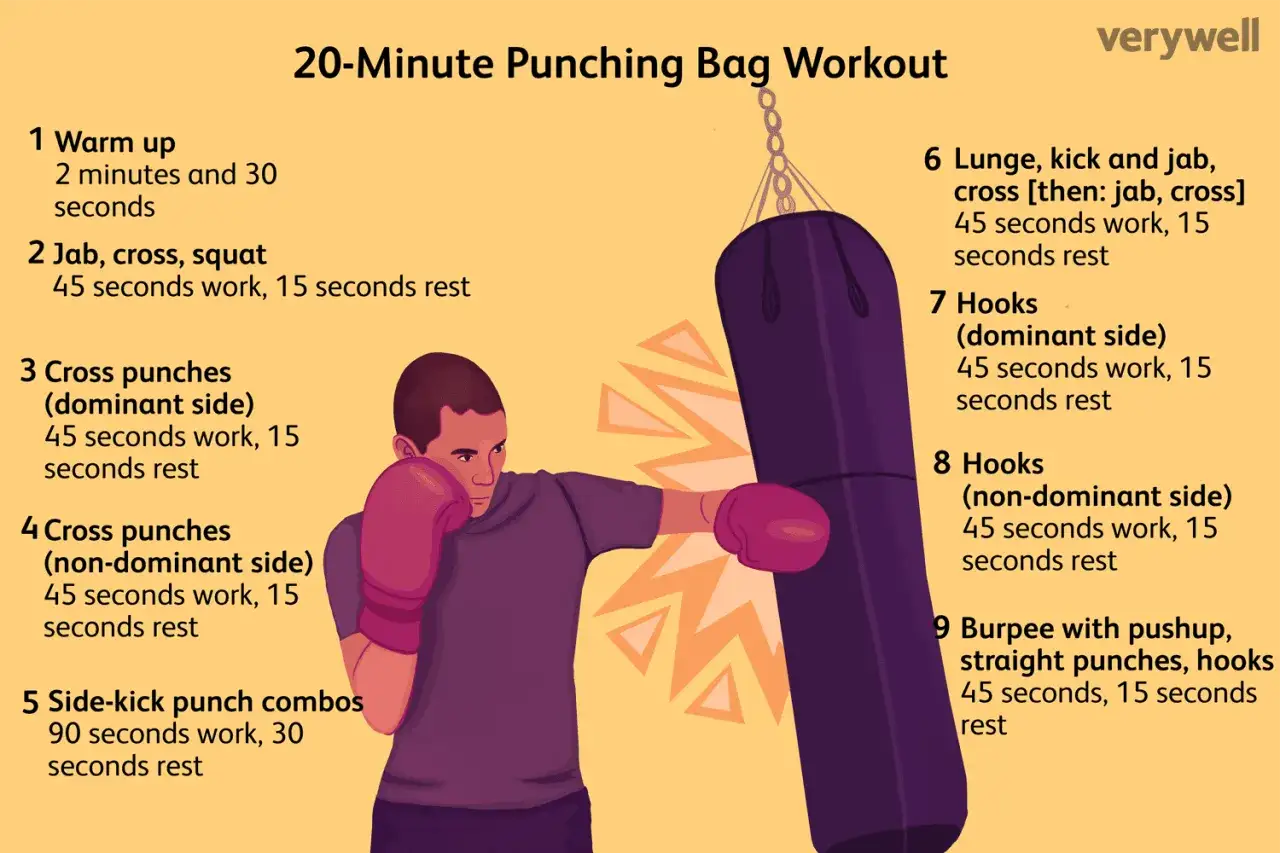
This is the format I would give someone who wants a clear starting point without guessing their way through the bag. It takes about 20-25 minutes including the warm-up and cool-down, and it is structured to build rhythm before intensity.
- Warm-up for 5 minutes. Do 1 minute of jump rope or marching in place, 1 minute of shoulder circles and arm swings, 1 minute of hip mobility, and 2 minutes of light shadowboxing.
- Round 1 - jab only. Move around the bag, touch with the jab, and reset your feet after every 2-3 punches.
- Round 2 - jab-cross. Keep the cross straight, rotate the rear hip, and step out after the combination.
- Round 3 - add the hook. Work jab-cross-hook, then come back to guard before you throw again.
- Round 4 - body-head changes. Touch the body, come back upstairs, and keep your knees bent instead of reaching with your shoulders.
- Round 5 - defense and entry. Slip, roll, or step before you start the combination, then exit on an angle.
- Round 6 - controlled pressure. Pick your best 2- or 3-punch combination and raise the pace, but keep the form clean. If you cannot keep the guard up, you are already past the right intensity.
- Cool down for 3-5 minutes. Walk, breathe, and loosen the shoulders, hips, and calves.
If that feels too ambitious, cut it to 4 rounds and keep the same round themes. I would rather see someone finish four disciplined rounds than slog through six messy ones. That difference matters more than people expect, because quality repetitions are what make bag work carry over into boxing.
Choosing the right bag and gear for your space
Equipment does not need to be fancy, but it should match your goal. A heavier hanging bag is usually better if you want power and realistic rebound. A freestanding bag makes more sense in apartments, garages, or any setup where ceiling mounting is not practical. Longer bags are useful when you want body shots, low kicks, or more striking surface, while shorter bags are easier to manage for straight boxing work.
| Option | Best for | Tradeoff |
|---|---|---|
| Hanging heavy bag | Power, realism, stable striking | Needs proper ceiling or stand space |
| Freestanding bag | Small spaces, easy setup, home conditioning | Can move more if the base is light |
| Long bag | Body shots, low targets, varied combinations | Takes up more room |
| Shorter bag | Beginners, straight punches, compact spaces | Less surface for lower targets |
For hand protection, I always prefer wraps and gloves that fit snugly enough to stabilize the wrist without cutting off circulation. If your hands slide inside the glove or your wrist bends on impact, fix that before you add more rounds. A timer is also worth having, because the structure of the round is part of the training effect.
Once the setup is right, the next thing that usually breaks the session is not equipment, but the way people hit the bag.
The mistakes that waste power and add risk
These are the mistakes I see most often, and they are easy to spot once you know what to look for.
- Arm punching. If the shoulders do all the work, the shot feels fast but flat, and your energy disappears early.
- Leaning into the bag. People do this when they want more force, but it usually kills balance and encourages poor posture.
- Holding the breath. This is one of the fastest ways to gas out. Exhale on the shot and inhale on the reset.
- Staying in one place. Boxing is not just hand speed. If your feet never move, the round becomes a stationary conditioning drill.
- Throwing every punch at full power. Hard shots have a place, but every round at max effort is a quick road to sloppy technique and sore joints.
- Ignoring hand pain. Knuckle, wrist, or thumb pain is a sign to adjust your wraps, gloves, or volume instead of forcing another round.
When I correct these mistakes, the workout usually gets better immediately. The session feels harder in the right way, and the punches start looking like boxing again instead of random impacts.
The final piece is planning how often to use the bag so the work keeps building instead of flattening out.
How to make the bag useful long after the first few sessions
If you want a punching bag workout that keeps paying off after the novelty wears off, track rounds, rest, and clean technique instead of just chasing sweat. That keeps the bag useful as both conditioning and boxing practice, which is the balance most people are actually after.
- Add volume slowly. One extra round is usually a better progression than turning every shot into a power shot.
- Rotate the purpose of the session. One day can be technical, one can be conditioning-focused, and one can be heavier power work.
- Leave room for recovery. If your shoulders, wrists, or elbows stay sore for days, cut back before the mechanics break down.
- Record one or two combos that felt clean and repeat them next session before adding complexity.
- Use the bag alongside shadowboxing, pads, strength work, and mobility so it supports the rest of your boxing training instead of replacing it.
That is the version I trust: structured rounds, good breathing, honest technique, and just enough intensity to force adaptation without turning the workout into guesswork.